Midterm 01
Practice problems for topics on Midterm 01. See Sample Midterm 01 to get a sense of the format of the exam.
Tags in this problem set:
Problem #01
Tags: nearest neighbor
Consider the data set shown below:
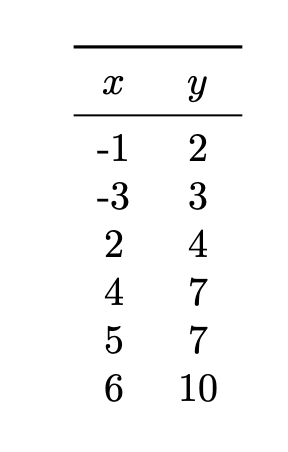
What is the predicted value of \(y\) at \(x = 3\) if the 3-nearest neighbor rule is used?
Solution
6
Problem #02
Tags: linear prediction functions
Suppose a linear prediction rule \(H(\vec x; \vec w) = \Aug(\vec x) \cdot\vec w\) is parameterized by the weight vector \(\vec w = (3, -2, 5, 2)^T\). Let \(\vec z = (1, -1, -2)^T\). What is \(H(\vec z)\)?
Solution
-8
Problem #03
Tags: linear regression, least squares
Suppose a line of the form \(H(x) = w_0 + w_1 x\) is fit to a data set of points \(\{(x_i, y_i)\}\) in \(\mathbb R^2\) by minimizing the mean squared error. Let the mean squared error of this predictor with respect to this data set be \(E_1\).
Next, create a new data set by adding a single new point to the original data set with the property that the new point lies exactly on the line \(H(x) = w_0 + w_1 x\) that was fit above. Let the mean squared error of \(H\) on this new data set be \(E_2\).
Which of the following is true?
Solution
\(E_1 > E_2\)
Problem #04
Tags: linear prediction functions
Suppose a linear predictor \(H_1\) is fit on a data set \(X = \{\nvec{x}{i}, y_i\}\) of \(n\) points by minimizing the mean squared error, where each \(\nvec{x}{i}\in\mathbb R^d\).
Let \(Z = \{\nvec{z}{i}, y_i\}\) be the data set obtained from the original by standardizing each feature. That is, if a matrix were created with the \(i\)th row being \(\nvec{z}{i}\), then the mean of each column would be zero, and the variance would be one.
Suppose a linear predictor \(H_2\) is fit on this standardized data by minimizing the mean squared error.
True or False: \(H_1(\nvec{x}{i}) = H_2(\nvec{z}{i})\) for each \(i = 1, \ldots, n\).
Solution
True.
Problem #05
Tags: object type
Part 1)
Let \(\Phi\) be an \(n \times d\) design matrix, let \(\lambda\) be a real number, and let \(I\) be a \(d \times d\) identity matrix.
What type of object is \((\Phi^T \Phi + n \lambda I)^{-1}\)?
Solution
A \(d \times d\) matrix
Part 2)
Let \(\Phi\) be an \(n \times d\) design matrix, and let \(\vec y \in\mathbb R^n\). What type of object is \(\Phi^T \vec y\)?
Solution
A vector in \(\mathbb R^d\)
Part 3)
Let \(\vec w \in\mathbb R^{d+1}\), and for for each \(i \in\{1, 2, \ldots, n\}\) let \(\nvec{x}{i}\in\mathbb R^d\) and \(y_i \in\mathbb R\).
What type of object is:
Solution
A scalar
Part 4)
Let \(\vec w \in\mathbb R^{d+1}\), and for for each \(i \in\{1, 2, \ldots, n\}\) let \(\nvec{x}{i}\in\mathbb R^d\) and \(y_i \in\mathbb R\). Consider the empirical risk with respect to the square loss of a linear predictor on a data set of \(n\) points:
What type of object is \(\nabla R(\vec w)\); that is, the gradient of the risk with respect to the parameter vector \(\vec w\)?
Solution
A vector in \(\mathbb R^{d+1}\)
Problem #06
Tags: linear prediction functions
Let \(\nvec{x}{1} = (-1, -1)^T\) and \(\nvec{x}{2} = (1, 1)^T\). Suppose \(H\) is a linear prediction function, and that \(H(\nvec{x}{1}) = 2\) while \(H(\nvec{x}{2}) = -2\).
Let \(\nvec{x}{3} = (1,-1)^T\). What is \(H(\nvec{x}{3})\)?
Solution
0
Problem #07
Tags: computing loss
Consider the data set shown below. The ``\(\times\)'' points have label +1, while the ``o'' points have label -1. Shown are the places where a linear prediction function \(H\) is equal to zero, 1, and -1.
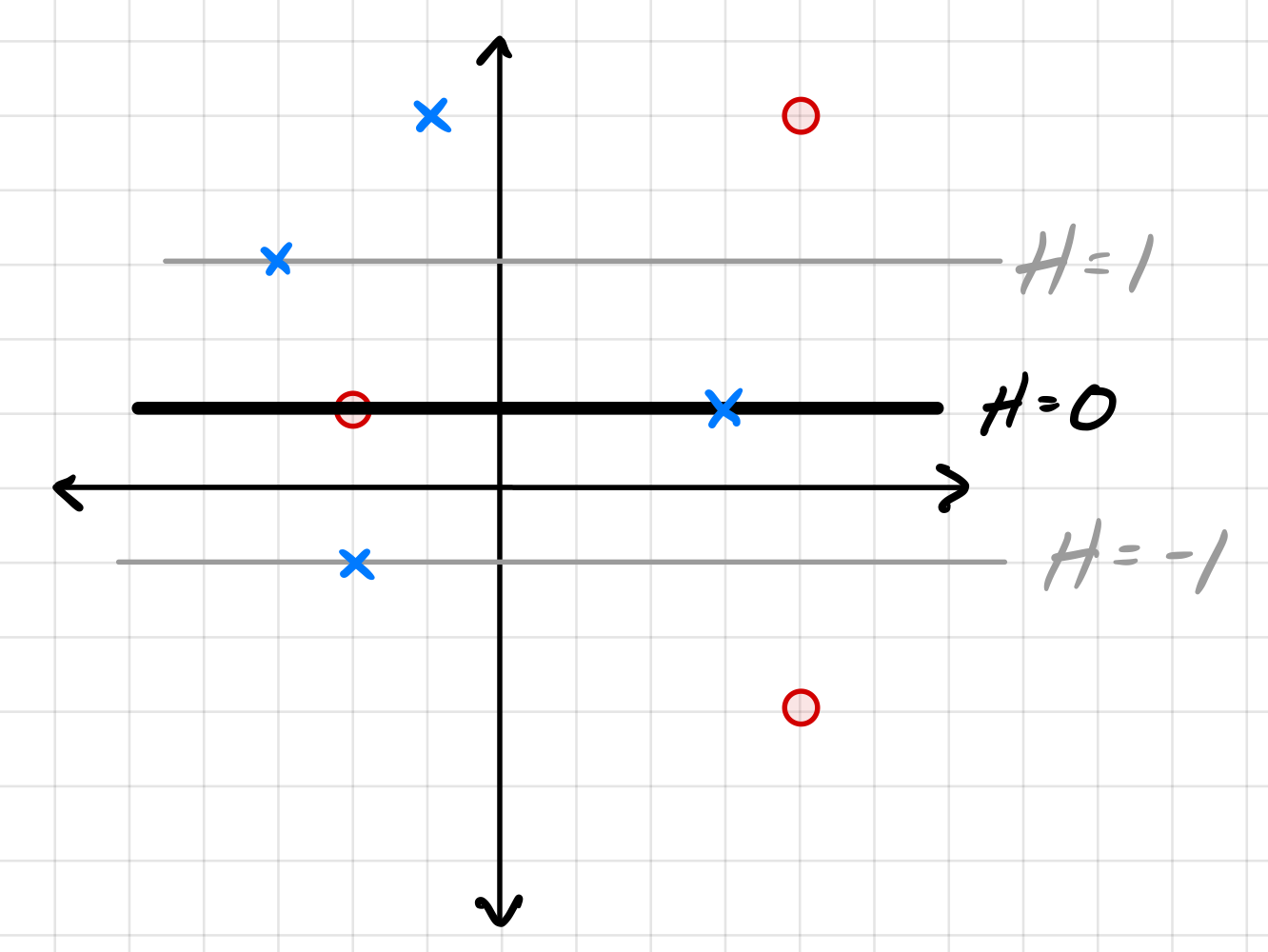
For each of the below subproblems, calculate the total loss with respect to the given loss function. That is, you should calculate \(\sum_{i=1}^n L(\nvec{x}{i}, y_i, \vec w)\) using the appropriate loss function in place of \(L\). Note that we have most often calculated the mean loss, but here we calculate the total so that we encounter fewer fractions.
Part 1)
What is the total square loss of \(H\) on this data set?
Solution
17
Part 2)
What is the total perceptron loss of \(H\) on this data set?
Solution
3
Part 3)
What is the total hinge loss of \(H\) on this data set?
Solution
7
Problem #08
Tags: subgradients
Consider the function \(f(x,y) = x^2 + |y|\). Plots of this function's surface and contours are shown below.
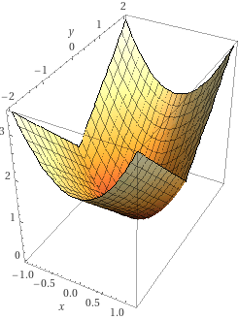
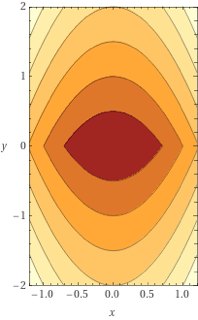
Which of the following are subgradients of \(f\) at the point \((0, 0)\)? Check all that apply.
Solution
\((0, 0)^T\), \((0, 1)^T\), and \((0, -1)^T\) are subgradients of \(f\) at \((0, 0)\).
Problem #09
Tags: gradient descent, perceptrons, gradients
Suppose gradient descent is to be used to train a perceptron classifier \(H(\vec x; \vec w)\) on a data set of \(n\) points, \(\{\nvec{x}{i}, y_i \}\). Recall that each iteration of gradient descent takes a step in the opposite direction of the ``gradient''.
Which gradient is being referred to here?
Solution
The gradient of the empirical risk with respect to \(\vec w\)
Problem #10
Tags: convexity
Let \(\{\nvec{x}{i}\}\) be a set of \(n\) vectors in \(\mathbb R^d\). Consider the function \(f(\vec w) = \sum_{i=1}^n \vec w \cdot\nvec{x}{i}\), where \(\vec w \in\mathbb R^d\).
True or False: \(f\) is convex as a function of \(\vec w\).
Solution
True.
Problem #11
Tags: SVMs
Let \(X = \{\nvec{x}{i}, y_i\}\) be a data set of \(n\) points where each \(\nvec{x}{i}\in\mathbb R^d\).
Let \(Z = \{\nvec{z}{i}, y_i\}\) be the data set obtained from the original by standardizing each feature. That is, if a matrix were created with the \(i\)th row being \(\nvec{z}{i}\), then the mean of each column would be zero, and the variance would be one.
Suppose that \(X\) and \(Z\) are both linearly-separable. Suppose Hard-SVMs \(H_1\) and \(H_2\) are trained on \(X\) and \(Z\), respectively.
True or False: \(H_1(\nvec{x}{i}) = H_2(\nvec{z}{i})\) for each \(i = 1, \ldots, n\).
Solution
False.
Problem #12
Tags: least squares
Suppose a data set \(\{\nvec{x}{i}, y_i\}\) is linearly-separable.
True or false: a least squares classifier trained on this data set is guaranteed to achieve a training error of zero.
Solution
False
Problem #13
Tags: SVMs
The image below shows a linear prediction function \(H\) along with a data set; the ``\(\times\)'' points have label +1 while the ``\(\circ\)'' points have label -1. Also shown are the places where the output of \(H\) is 0, 1, and -1.
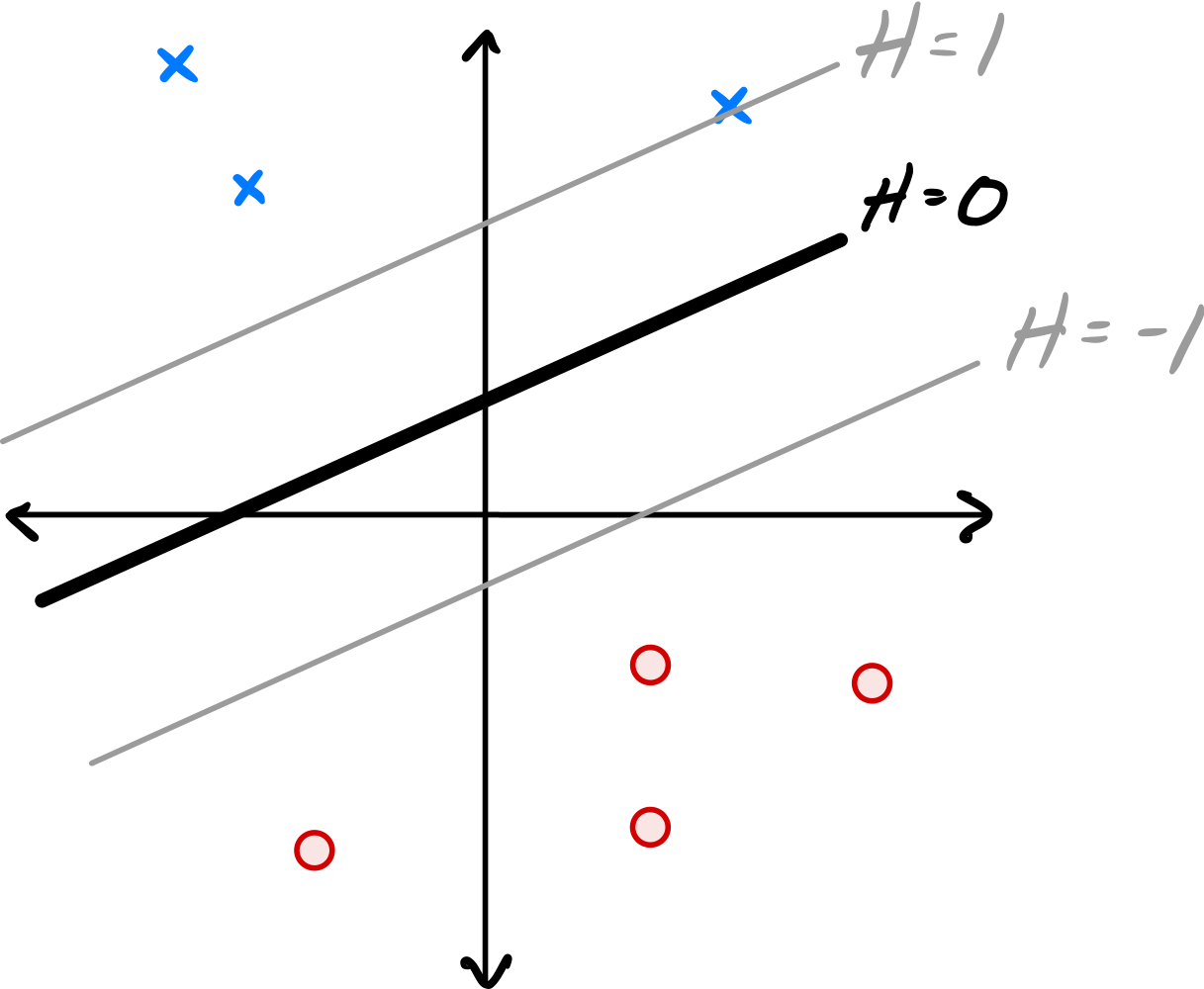
True or False: \(H\) could have been learned by training a Hard-SVM on this data set.
Solution
False.
The solution to the Hard-SVM problem is a hyperplane that separates the two classes with the maximum margin.
In this solution, the margin is not maximized: There is room for the ``exclusion zone'' between the two classes to grow, and for the margin to increase.
Problem #15
Tags: regularization
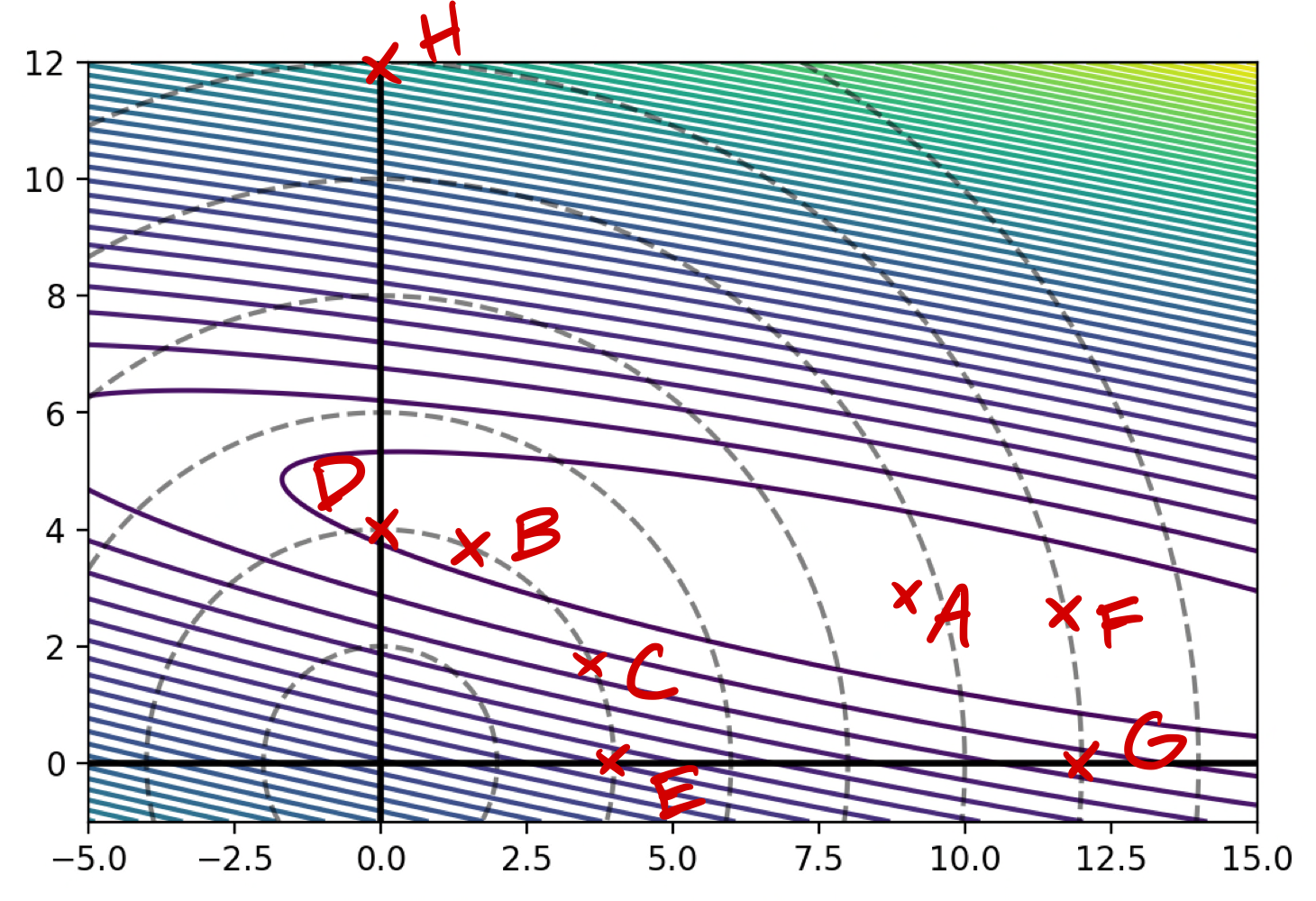
Let \(R(\vec w)\) be the unregularized empirical risk with respect to the square loss (that is, the mean squared error) on a data set.
The image below shows the contours of \(R(\vec w)\). The dashed lines show places where \(\|\vec w\|_2\) is 2, 4, 6, etc.
Part 1)
Assuming that one of the points below is the minimizer of the unregularized risk, \(R(\vec w)\), which could it possibly be?
Solution
A
Part 2)
Let the regularized risk \(\tilde R(\vec w) = R(\vec w) + \lambda\|\vec w \|_2^2\), where \(\lambda > 0\).
Assuming that one of the points below is the minimizer of the regularized risk, \(\tilde R(\vec w)\), which could it possibly be?
Solution
B
Problem #17
Tags: gradients
Let \(f(\vec w) = \vec a \cdot\vec w + \lambda\|\vec w \|^2\), where \(\vec w \in\mathbb R^d\), \(\vec a \in\mathbb R^d\), and \(\lambda > 0\).
What is the minimizer of \(f\)? State your answer in terms of \(\vec a\) and \(\lambda\).
Solution
\(\vec w^* = -\frac{\vec{a}}{2\lambda}\)
Problem #18
Tags: nearest neighbor
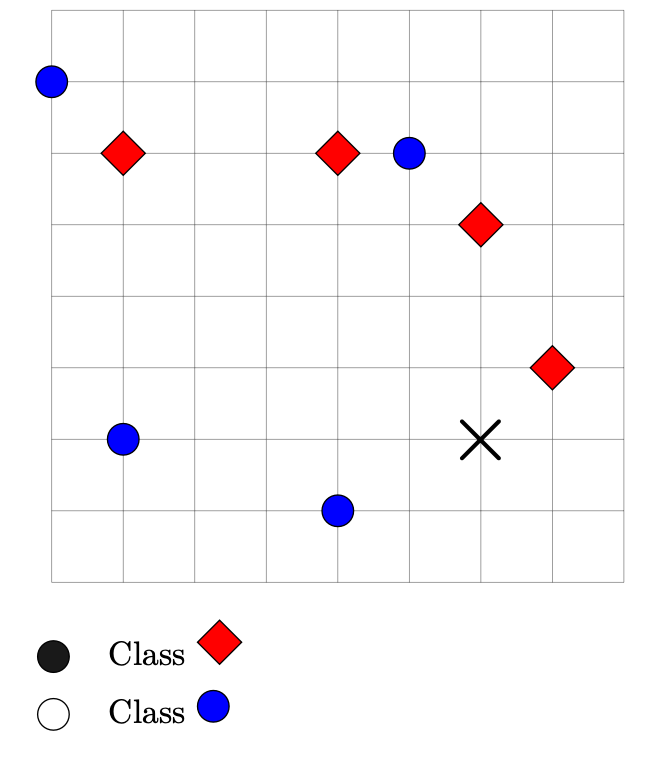
Consider the data set of diamonds and circles shown below. Suppose a \(k\)-nn classifier is used to predict the label of the new point marked by \(\times\), with \(k = 3\). What will be the prediction? You may assume that the Euclidean distance is used.
Problem #19
Tags: linear prediction functions
Suppose a linear prediction rule \(H(\vec x; \vec w) = \Aug(\vec x) \cdot\vec w\) is parameterized by the weight vector \(\vec w = (2, 1, -3, 4)^T\). Let \(\vec z = (3, -2, 1)^T\). What is \(H(\vec z)\)?
Solution
15
Problem #20
Tags: least squares
In the following, let \(\mathcal D_1\) be a set of points \((x_1, y_1), \ldots, (x_n, y_n)\) in \(\mathbb R^2\). Suppose a straight line \(H_1(x) = a_1 x + a_0\) is fit to this data set by minimizing the mean squared error, and let \(R_1\) the be mean squared error of this line.
Now create a second data set, \(\mathcal D_2\), by doubling the \(x\)-coordinate of each of the original points, but leaving the \(y\)-coordinate unchanged. That is, \(\mathcal D_2\) consists of points \((2x_1, y_1), \ldots, (2x_n, y_n)\). Suppose a straight line \(H_2(x) = b_1 x + b_0\) is fit to this data set by minimizing the mean squared error, and let \(R_2\) be the mean squared error of this line.
You may assume that all of the \(x_i\) are unique, as are all of the \(y_i\).
Part 1)
Which one of the following is true about \(R_1\) and \(R_2\)?
Solution
\(R_1 = R_2\)
Part 2)
Which one of the following is true about \(a_0\) and \(b_0\)(the intercepts)?
Solution
\(a_0 = b_0\)
Part 3)
Which one of the following is true about \(a_1\) and \(b_1\)(the slopes)?
Solution
\(a_1 > b_1\)
Problem #22
Tags: object type
Part 1)
Let \(\vec x \in\mathbb R^d\) and let \(A\) be an \(d \times d\) matrix. What type of object is \(\vec x^T A \vec x\)?
Solution
A scalar
Part 2)
Let \(A\) be an \(n \times n\) matrix, and let \(\vec x \in\mathbb R^n\). What type of object is: \((A + A^T)^{-1}x\)?
Solution
A vector in \(\mathbb R^n\)
Part 3)
Suppose we train a support vector machine \(H(\vec x) = \Aug(\vec x) \cdot\vec w\) on a data set of \(n\) points in \(\mathbb R^d\). What type of object is the resulting parameter vector, \(\vec w\)?
Solution
A vector in \(\mathbb R^{d+1}\)
Problem #23
Tags: linear prediction functions
Let \(\nvec{x}{1} = (-1, -1)^T\), \(\nvec{x}{2} = (1, 1)^T\), and \(\nvec{x}{3} = (-1,1)^T\). Suppose \(H\) is a linear prediction function, and that \(H(\nvec{x}{1}) = 2\), \(H(\nvec{x}{2}) = -2\), and \(H(\nvec{x}{3}) = 2\).
Let \(\vec z = (2,-1)^T\). What is \(H(\vec z)\)?
Solution
-4
Problem #24
Tags: computing loss
Consider the data set shown below. The ``\(\times\)'' points have label -1, while the ``\(\circ\)'' points have label +1. Shown are the places where a linear prediction function \(H\) is equal to zero (the thick solid line), 1, and -1 (the dotted lines). Each cell of the grid is 1 unit by 1 unit.
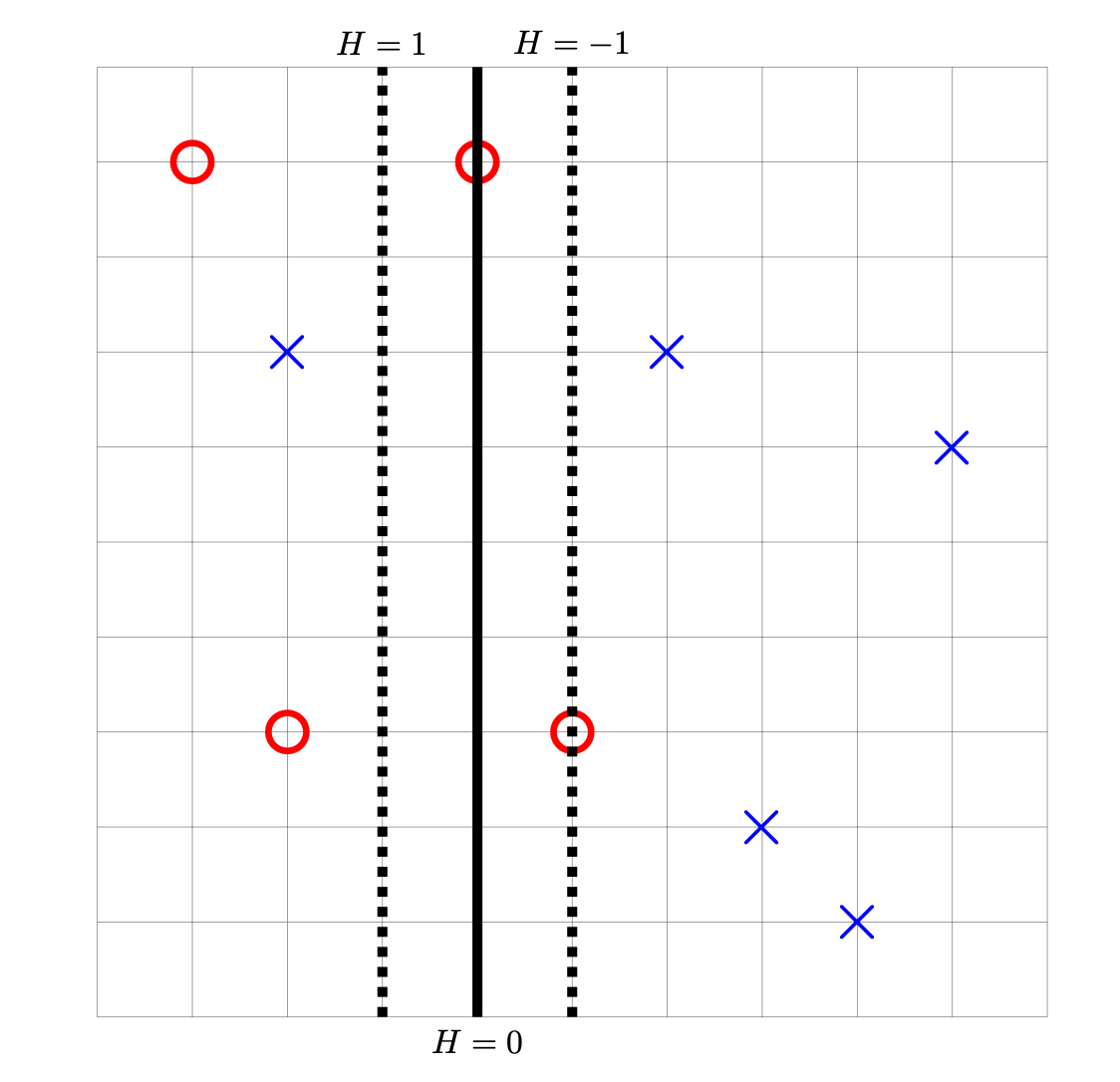
For each of the below subproblems, calculate the total loss with respect to the given loss function. That is, you should calculate \(\sum_{i=1}^n L(\nvec{x}{i}, y_i, \vec w)\) using the appropriate loss function in place of \(L\). Note that we have most often calculated the mean loss, but here we calculate the total so that we encounter fewer fractions.
Part 1)
What is the total square loss of \(H\) on this data set?
Solution
49
Part 2)
What is the total perceptron loss of \(H\) on this data set?
Solution
3
Part 3)
What is the total hinge loss of \(H\) on this data set?
Solution
6
Problem #25
Tags: subgradients
Consider the function \(f(x,y) = |x| + y^4\). Plots of this function's surface and contours are shown below.
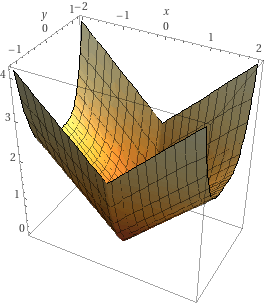
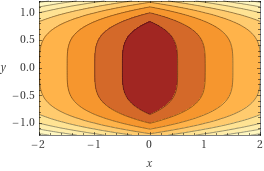
Write a valid subgradient of \(f\) at the point \((0, 1)\).
There are many possibilities, but you need only write one. For the simplicity of grading, please pick a subgradient whose coordinates are both integers, and write your answer in the form \((a, b)\), where \(a\) and \(b\) are numbers.
Solution
\((x, 4)\), where \(x \in[-1,1]\)
Problem #27
Tags: convexity
Consider the function \(f(x) = x^4 - x^2\) True or False: \(f\) is convex as a function of \(x\).
Solution
False.
Problem #28
Tags: SVMs
Suppose a data set \(\mathcal D\) is linearly separable. True or False: a Hard-SVM trained of \(\mathcal D\) is guaranteed to achieve 100\% training accuracy.
Solution
True.
Problem #29
Tags: gradient descent
Consider the function \(f(x, y) = x^2 + xy + y^2\). Suppose that a single iteration of gradient descent is run on this function with a starting location of \((1, 2)^T\) and a learning rate of \(\eta = 1/10\). What will be the \(x\) and \(y\) coordinates after this iteration?
Solution
\(x = 0.6\), \(y = 1.5\)
Problem #30
Tags: SVMs
The image below shows a linear prediction function \(H\) along with a data set; the ``\(\times\)'' points have label +1 while the ``\(\circ\)'' points have label -1. Also shown are the places where the output of \(H\) is 0, 1, and -1.
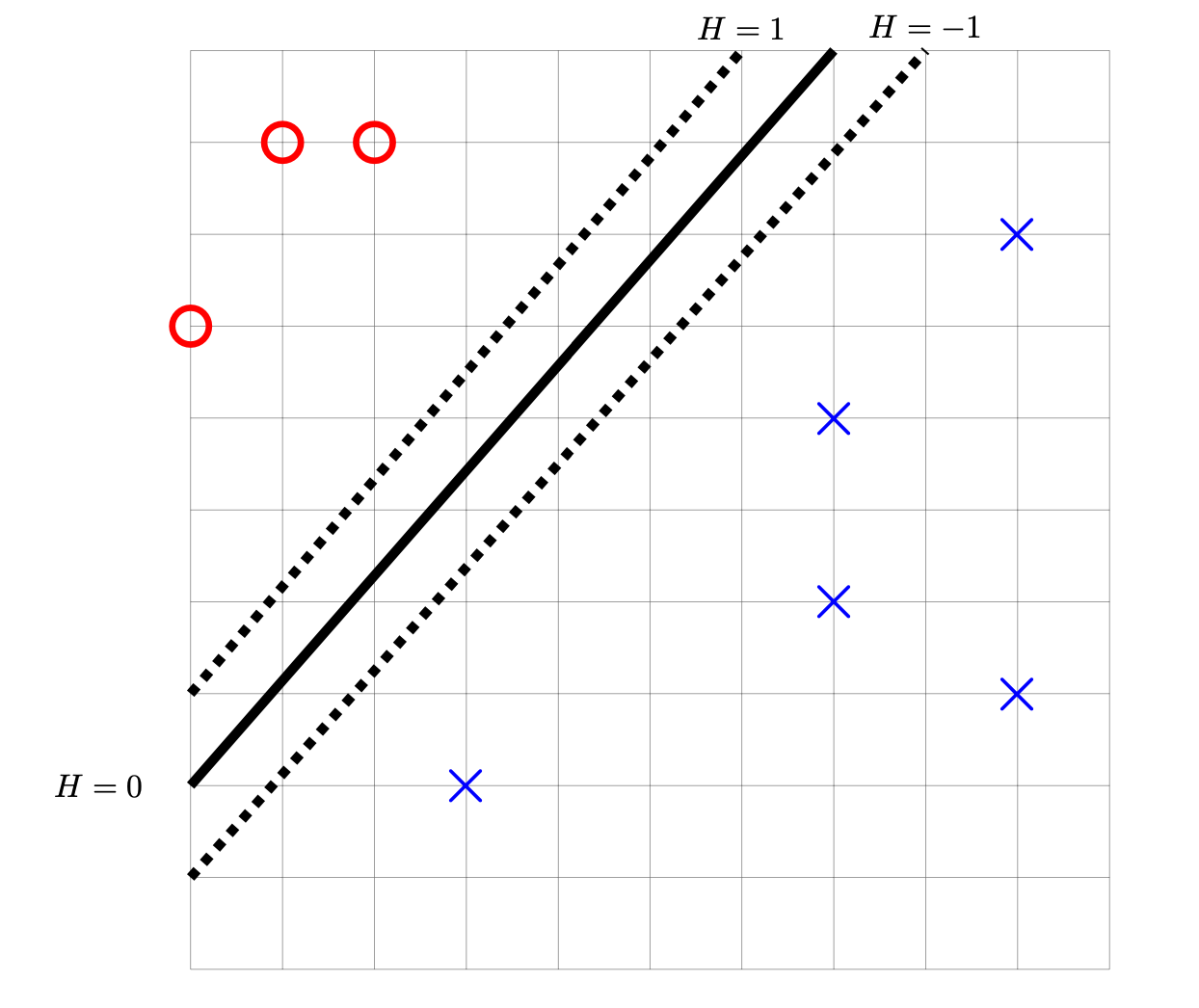
True or False: \(H\) could have been learned by training a Hard-SVM on this data set.
Solution
False.
Problem #32
Tags: regularization
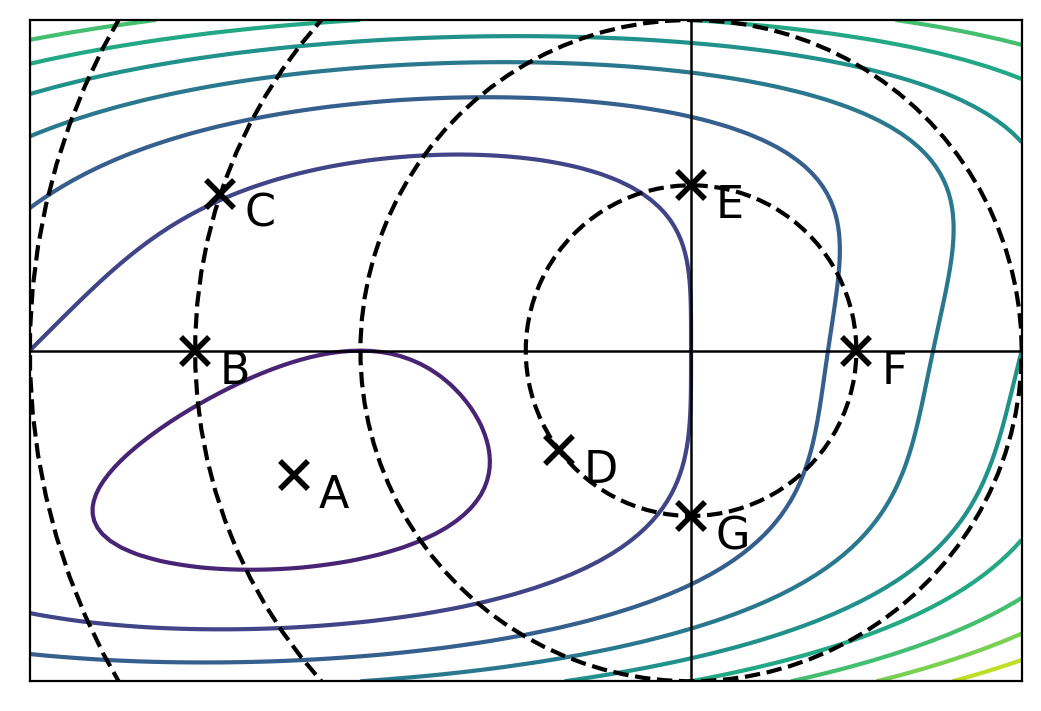
Let \(R(\vec w)\) be an unregularized empirical risk function with respect to some data set.
The image below shows the contours of \(R(\vec w)\). The dashed lines show places where \(\|\vec w\|_2\) is 1, 2, 3, etc.
Part 1)
Assuming that one of the points below is the minimizer of the unregularized risk, \(R(\vec w)\), which could it possibly be?
Solution
A minimizer of the unregularized risk could be point A.
Part 2)
Let the regularized risk \(\tilde R(\vec w) = R(\vec w) + \lambda\|\vec w \|_2^2\), where \(\lambda > 0\).
Assuming that one of the points below is the minimizer of the regularized risk, \(\tilde R(\vec w)\), which could it possibly be?
Solution
A minimizer of the regularized risk could be point D.