Problems tagged with "SVMs"
Problem #11
Tags: SVMs
Let \(X = \{\nvec{x}{i}, y_i\}\) be a data set of \(n\) points where each \(\nvec{x}{i}\in\mathbb R^d\).
Let \(Z = \{\nvec{z}{i}, y_i\}\) be the data set obtained from the original by standardizing each feature. That is, if a matrix were created with the \(i\)th row being \(\nvec{z}{i}\), then the mean of each column would be zero, and the variance would be one.
Suppose that \(X\) and \(Z\) are both linearly-separable. Suppose Hard-SVMs \(H_1\) and \(H_2\) are trained on \(X\) and \(Z\), respectively.
True or False: \(H_1(\nvec{x}{i}) = H_2(\nvec{z}{i})\) for each \(i = 1, \ldots, n\).
Solution
False.
Problem #13
Tags: SVMs
The image below shows a linear prediction function \(H\) along with a data set; the ``\(\times\)'' points have label +1 while the ``\(\circ\)'' points have label -1. Also shown are the places where the output of \(H\) is 0, 1, and -1.
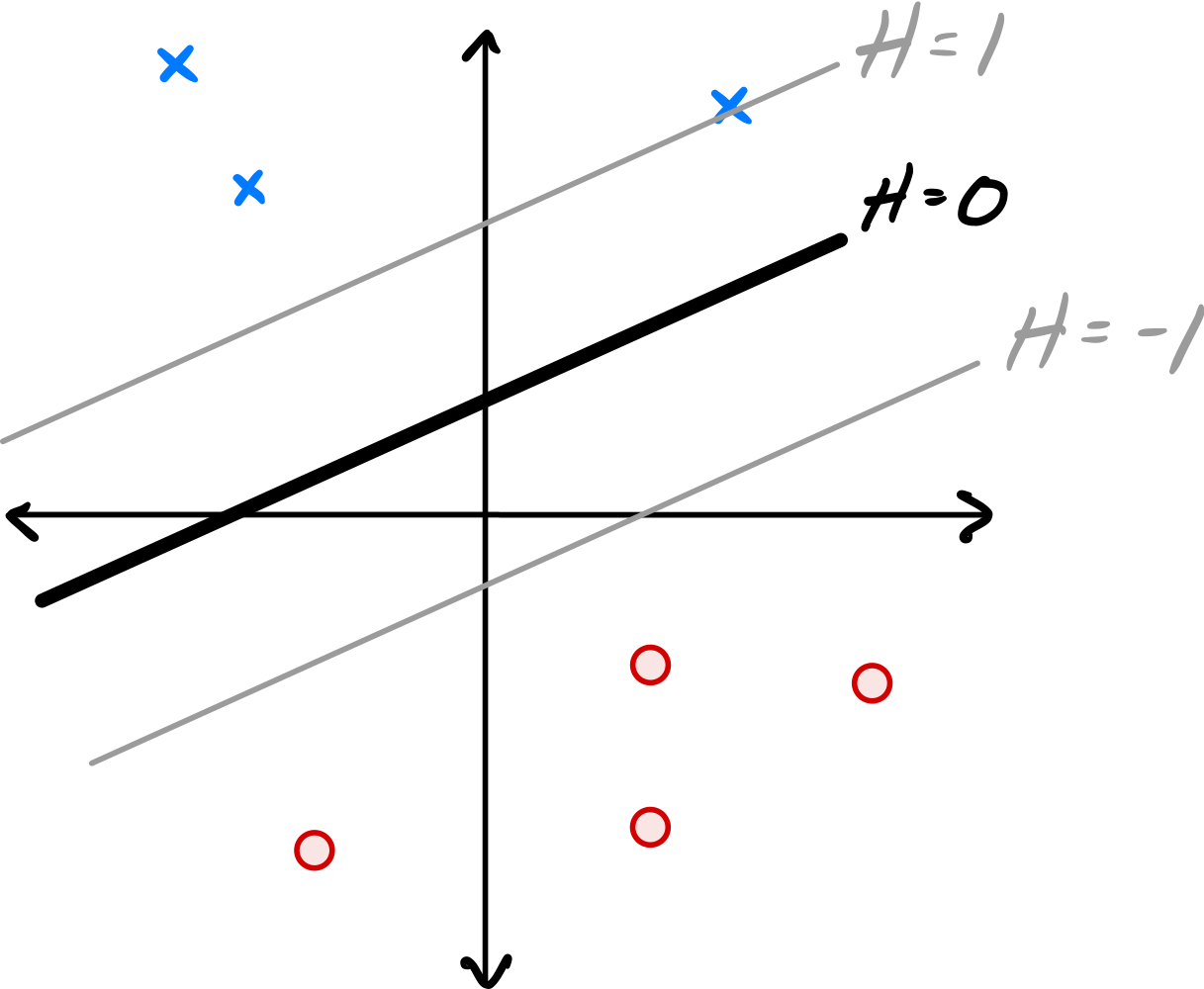
True or False: \(H\) could have been learned by training a Hard-SVM on this data set.
Solution
False.
The solution to the Hard-SVM problem is a hyperplane that separates the two classes with the maximum margin.
In this solution, the margin is not maximized: There is room for the ``exclusion zone'' between the two classes to grow, and for the margin to increase.
Problem #28
Tags: SVMs
Suppose a data set \(\mathcal D\) is linearly separable. True or False: a Hard-SVM trained of \(\mathcal D\) is guaranteed to achieve 100\% training accuracy.
Solution
True.
Problem #30
Tags: SVMs
The image below shows a linear prediction function \(H\) along with a data set; the ``\(\times\)'' points have label +1 while the ``\(\circ\)'' points have label -1. Also shown are the places where the output of \(H\) is 0, 1, and -1.
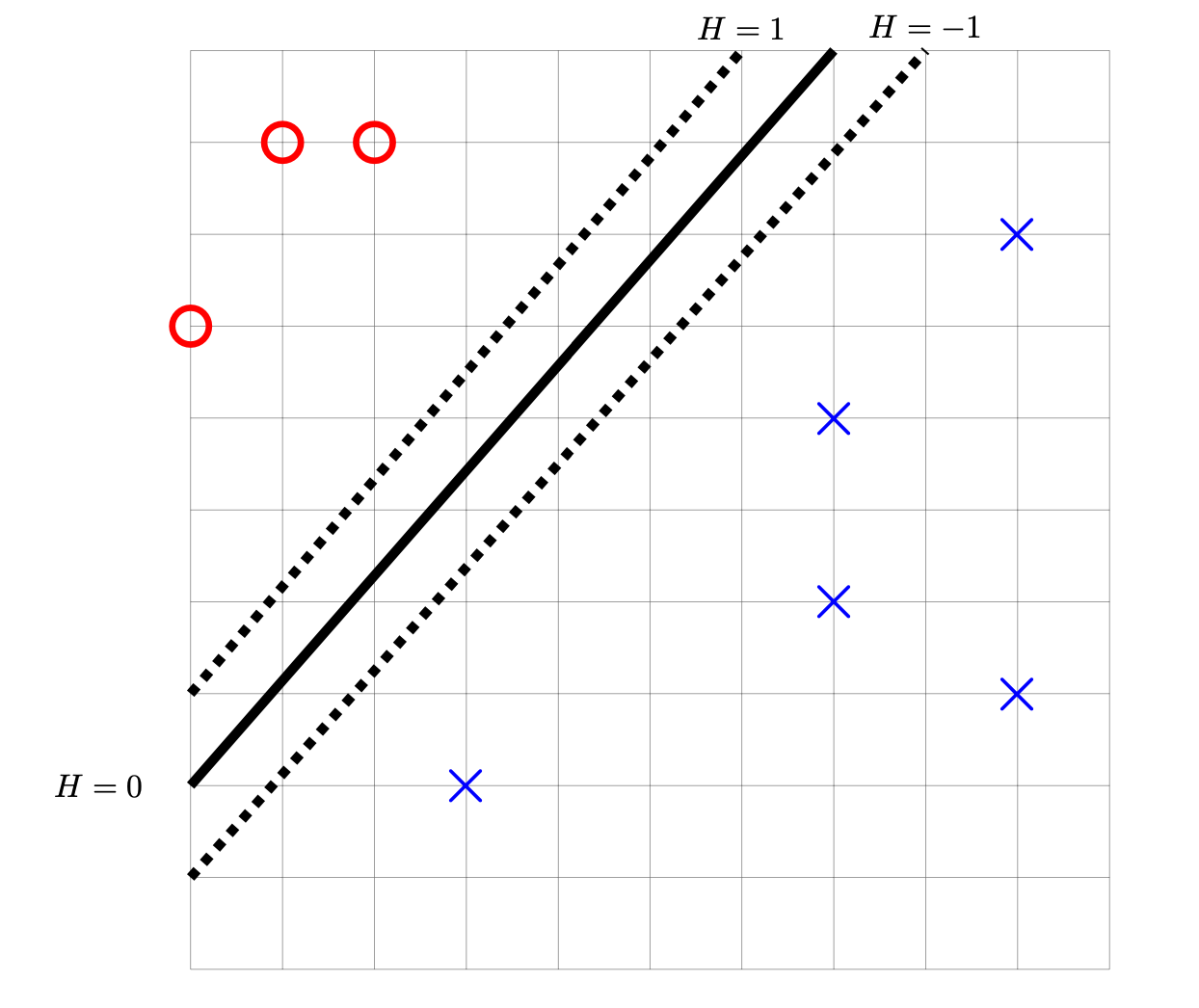
True or False: \(H\) could have been learned by training a Hard-SVM on this data set.
Solution
False.